
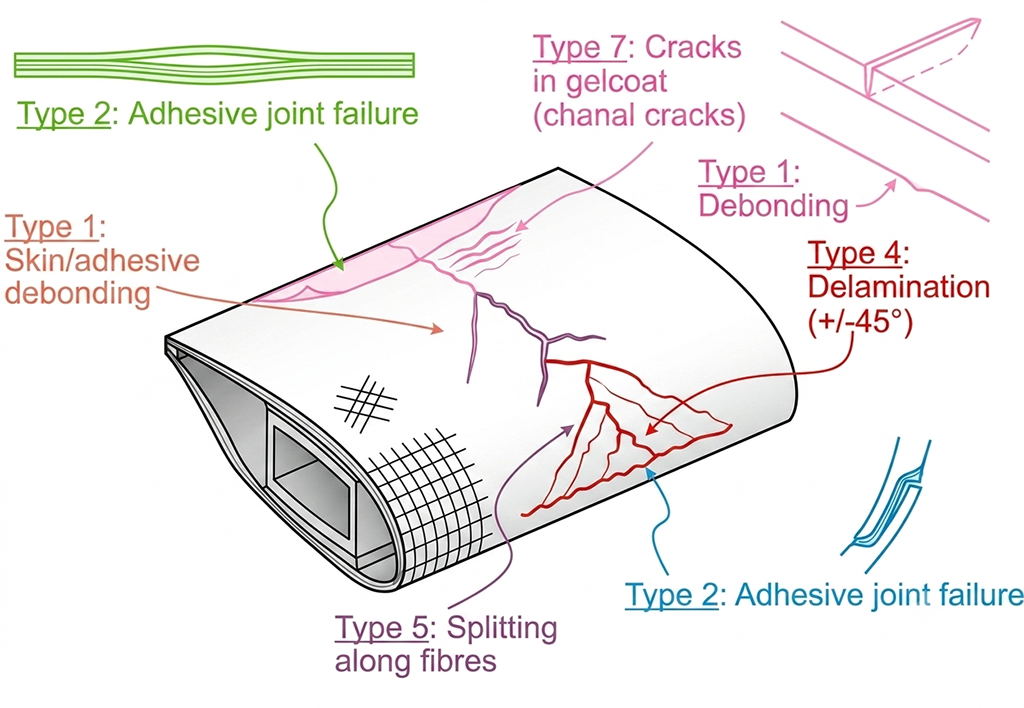
Fig. 1 – Common damages observed in the aeroshell of a wind turbine blade[3]
Wind energy is one of the most promising renewable sources for the transition to sustainable energy generation, with installed capacity exceeding, 1136 GW in 20241 . Wind turbine blades are the most critical and expensive components, they consist of fibre-reinforced polymer (FRP) shells bonded together using structural adhesives, predominantly epoxy (EP), applied along the leading edge, trailing edge, spar cap and shear web2-3 . Wind turbine blades are subject to various types of damage during their operational life, which can be divided into three broad categories: surface degradation (such as leading-edge erosion and damage of the coating), interface and bond line deterioration (including adhesive joint failure) and damage to structural elements (such as delamination, fibre breakage or instability). Although leading-edge erosion is a frequently observed damage mechanism and often appears within the first few years of service, the failure of adhesive joints is of critical importance due to the risk of total loss of structural integrity, as well as the associated maintenance costs and complexity. Indeed, given the size of modern wind turbine blades (over 100 m), even small defects in the adhesives can lead to structural failure3 .
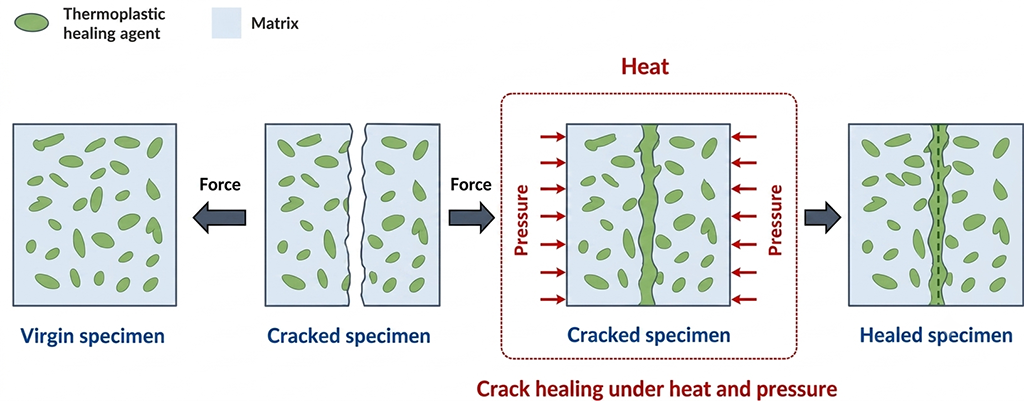
Fig. 2 – Stages of breakage and mending through heat and pressure of an intrinsic self-healing material consisting of a thermoplastic healing agent dispersed in a matrix
To increase the durability of these components, research is focusing on self-healing materials, which are classified as either intrinsic systems, based on reversible bonds, for example, achieved by introducing thermoplastic phases, or extrinsic systems, based on strong bonds achieved, for example, by introducing encapsulated reactive healing agents4 . However, many of these systems exhibit reduced mechanical properties, making them unsuitable for structural applications5-8 . In this context, cyclic olefin copolymers (COCs) are emerging as promising repair agents thanks to their wide glass transition temperature range (68-180° C), high thermal stability and mechanical properties similar to those of epoxy resins, ensuring that structural integrity is not compromised9 . These are transparent, amorphous thermoplastics with low density, high stiffness and excellent moisture barrier properties, which are used in precision optics (lenses), the medical sector (syringes and diagnostic containers), pharmaceutical and food packaging, and electronic components10 .
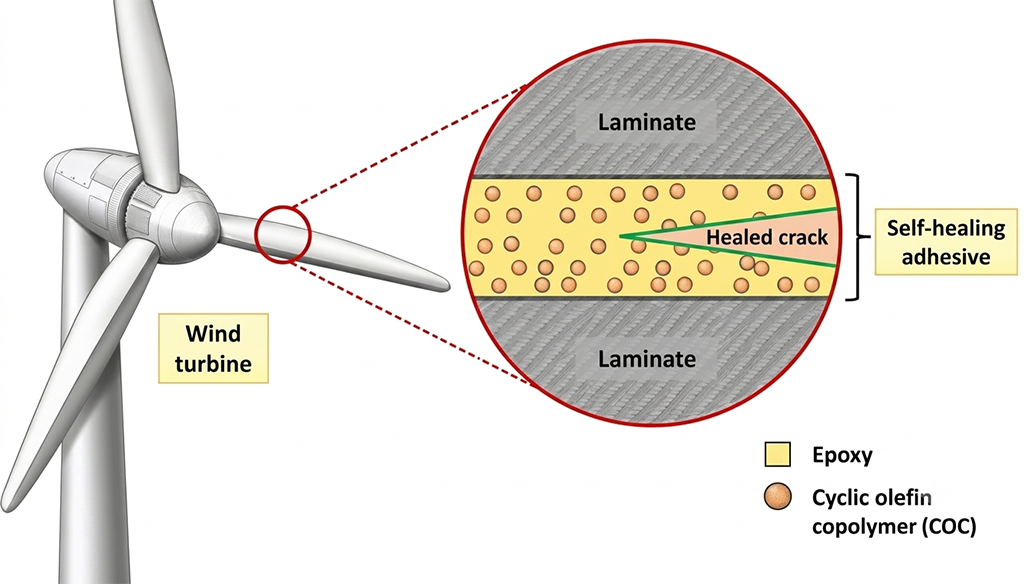
In this study11 , the selected COC was cryo-grinded into particles smaller than 300 μm and mixed with the epoxy resin at concentrations of 15% and 30% by weight, whilst the joints were formed by bonding two carbon fibre laminate substrates with a 0.75 mm layer of adhesive.
From a rheological point of view, the addition of COC to the uncured epoxy matrix increased the storage modulus, the loss modulus and the complex viscosity, indicating that the COC domains restrict the mobility of the epoxy chains at the cross-linking temperature (70° C). However, processability was not compromised. Chemical and morphological analyses confirmed that the polymer blend was immiscible, with COC domains dispersed within the matrix and weakly interacting with it, as evidenced by micro-voids at the interface.
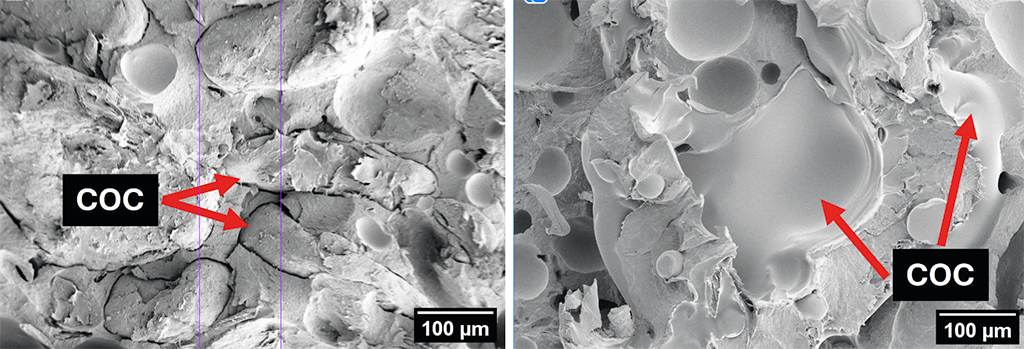
The system exhibited complete curing and good thermal stability, with improved resistance to thermal degradation upon the addition of COC compared with the neat resin. The addition of COC led to a slight increase in the elastic modulus from 1.65 to 1.75 GPa, without the samples showing any significant difference. Nevertheless, it reduced tensile strength and elongation at break due to limited interfacial adhesion, the decreases observed for the blend containing 30% COC were 32% and 68%, respectively. Fracture toughness (KIC and GIC) decreased slightly with the addition of COC. However, during repair at 175° C, the softened COC effectively flowed into the damaged area. The mixture containing 30% of COC achieved an 81% recovery in fracture toughness (KIC ) following repair at 175 °C. Joints made with epoxy resin alone exhibited the highest shear strength (16.2 MPa), whilst the addition of COC led to a reduction in initial strength (14.9 MPa for the mixture containing 30% COC). After the repair process at 175° C, the joint containing 30% COC recovered approximately 43% of its original shear strength. Observations under an optical microscope revealed a transition from an adhesive failure (which occurs at the interface and is therefore difficult to repair) observed in joints with neat epoxy adhesive and with the epoxy/COC mixture containing 15% of COC, to a cohesive failure (within the adhesive and therefore easily healable) in the presence of 30% of COC, indicating that COC modifies the failure mechanism and the interaction between the adhesive and the substrate. This study has demonstrated that EP/COC blends may represent a new type of thermally self-healing adhesive. Although the introduction of the thermoplastic phase partially reduces the initial mechanical properties, the system ensures adequate structural performance and significant self-healing capability, particularly with a COC content of 30% by weight and self-healing temperatures of 175° C. These adhesives could significantly increase the reliability and service life of wind turbine blades in harsh environmental conditions, thereby reducing maintenance costs. Further research could focus on fatigue resistance and on triggering the repair mechanism through additional external stimuli to simplify the repair process.
BIBLIOGRAPHY
1. Global Wind Energy Council (GWEC). Global Wind Report 2025. https://www.gwec.net/reports/globalwindreport#Download, (accessed 20/10/2025).
2. L. J. Mishnaevsky. Root Causes and Mechanisms of Failure of Wind Turbine Blades: Overview. Materials 15 (2022) 2959–2987.
3. A. G. Olabi, T. Wilberforce, K. Elsaid, E. T. Sayed, T. Salameh, M. A. Abdelkareem, A. Baroutaji. A Review on Failure Modes of Wind Turbine Components. Energies 14 (2021).
4. E. K. Kumar, S. S. Patel, V. Kumar, S. K. Panda, S. R. Mahmoud, M. Balubaid. State of Art Review on Applications and Mechanism of Self-Healing Materials and Structure. Archives of Computational Methods in Engineering 30 (2022) 1041-1055.
5. M. Kosarli, D. G. Bekas, K. Tsirka, D. Baltzis, D. Τ. Vaimakis-Tsogkas, S. Orfanidis, G. Papavassiliou, A. S. Paipetis. Microcapsule-based self-healing materials: Healing efficiency and toughness reduction vs. capsule size. Composites Part B: Engineering 171 (2019) 78-86.
6. W. Zhang, J. Duchet, J. F. Gérard. Self-healable interfaces based on thermo-reversible Diels–Alder reactions in carbon fiber reinforced composites. Journal of Colloid and Interface Science 430 (2014) 61-68.
7. B. Strachota, J. Hodan, J. Dybal, L. Matějka. Self‐Healing Epoxy and Reversible Diels‐Alder Based Interpenetrating Networks. Macromolecular Materials and Engineering 306 (2020) 2000474-2000487.
8. R. Malekkhouyan, R. E. Neisiany, S. N. Khorasani, O. Das, F. Berto, S. Ramakrishna. The influence of size and healing content on the performance of extrinsic self‐healing coatings. Journal of Applied Polymer Science 138 (2020) 49964-49977.
9. D. Perin, H. Mahmood, D. Rigotti, A. Dorigato, A. Pegoretti. Novel epoxy/cyclic olefin copolymer/carbon structural composites with electro‐activated self‐healing properties. Polymer Composites 44 (2023) 5173-5187.
10. D. M. R. R. Lamonte. Cyclic Olefin Copolymers. Advanced Materials & Processes 159 (2001) 33-36.
11. N. Truschelli, L. Simonini, A. Tempelis, L. Mishnaevsky Jr, A. Pegoretti, A. Dorigato. Development of self-healing epoxy/COC adhesives for potential use in wind turbine blades. Composites Part A: Applied Science and Manufacturing 205 (2026) 109732-109743.