
INTRODUCTION
In today’s fast-paced industrial environment, maximizing production efficiency is essential. Thixatrol® AS 8053 introduces a new paradigm: post-production (on-demand) activation. This approach enables manufacturers to fill and package sealants and adhesives at lower viscosities, then activate the rheological additive directly in the final packaging, delivering flexibility, energy savings, and higher throughput without compromising performance.
FEATURES
• Labelling-free and based on renewable raw materials.
• On-demand activation – activated in final packaging via controlled heating.
• No heating during mixing – simplifies production and reduces time and energy use.
• Stable storage – no viscosity drift over time (3 weeks at 50º C).
• Lower viscosity during filling – easier cartridge processing.
• Clear time/temp guidelines.
TARGET APPLICATION
• Hybrid sealants for construction.
• Industrial adhesives and sealants.
• Automotive sealants.
• High solids polyurethane / epoxy systems.
FORMULATION ADN PROCESS CONSIDERATIONS
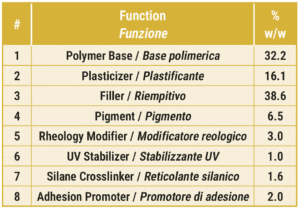
This approach is intended to prove the concept and illustrate the potential benefits of shifting activation to the final packaging stage.To demonstrate the feasibility of post-production (on-demand) activation with Thixatrol® AS 8053, a generic silane modified polymer-based sealant formulation was selected as a model system (Tab. 1). The effectiveness of post-production activation depends on several factors:
• formulation composition: the specific polymer, plasticizer, filler, and additive choices can influence activation efficiency and final properties.
• Mixing and dispersion process: the quality of dispersion and mixing geometry affect rheology and activation outcomes.
• Post-activation conditions: temperature, time, and the type of heating equipment play a decisive role in achieving optimal viscosity and performance.
Customers are strongly encouraged to conduct their own assessments and optimization trials, as results may vary depending on their unique formulations, processing equipment, and production environment.
PRODUCTION PROCESS INNOVATION
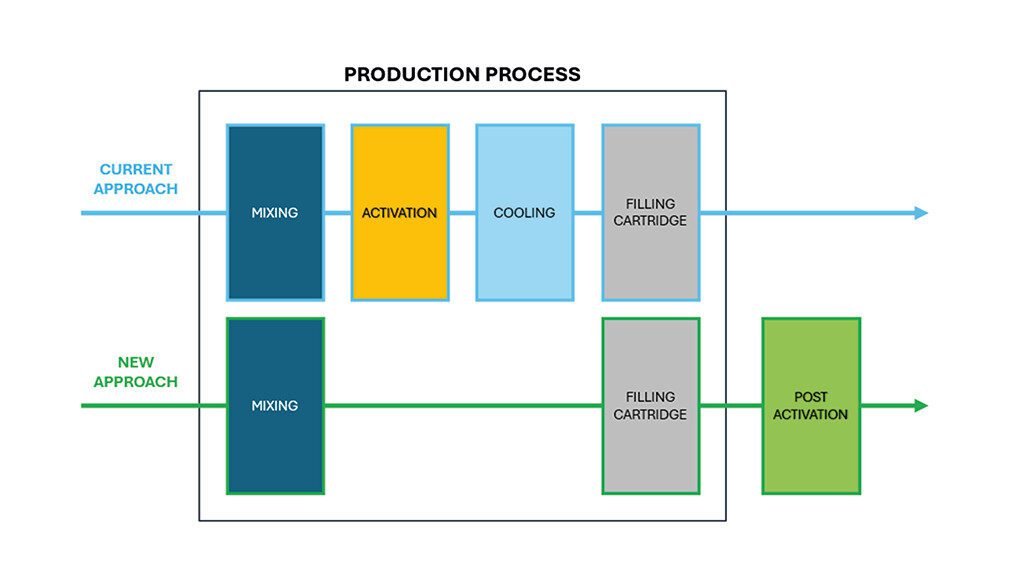
The new post-production (on-demand) activation approach for Thixatrol® AS 8053 revolutionizes sealant and adhesive manufacturing. By shifting activation to after packaging, manufacturers can fill cartridges at lower viscosity, eliminate in-process heating and cooling, and activate the product only when and where needed. This streamlines production, increases flexibility, and supports higher throughput (Fig. 1).
INCORPORATION AND RECOMMENDED USE LEVELS
Thixatrol® AS 8053 can be incorporated at the start of the mixing process, with all ingredients. After filling, activate the product in its final packaging using controlled heat (e.g., oven, heated chamber, or tunnel).
Recommended activation temperature from 40º C to 55° C for 20 to 30 minutes although, optimal temperature of postactivation requires to be tested based on packaging and batch sizes. Typical dosage level from 1.0% to 3.5% of total formulation weight, though a ladder study is recommended for addition level optimization.
Thixatrol® AS 8053 enables adhesive and sealant manufacturers to operate at lower temperatures in production, saving energy, time, and money. Both methods, activation during production and post-activation benefit from the use of a highly efficient rheological additive, active at 40–60° C, with 75% bio-based origin and compatible with all types of solvent-based systems.
PERFORMANCE DATA AND COMPARATIVE TESTING
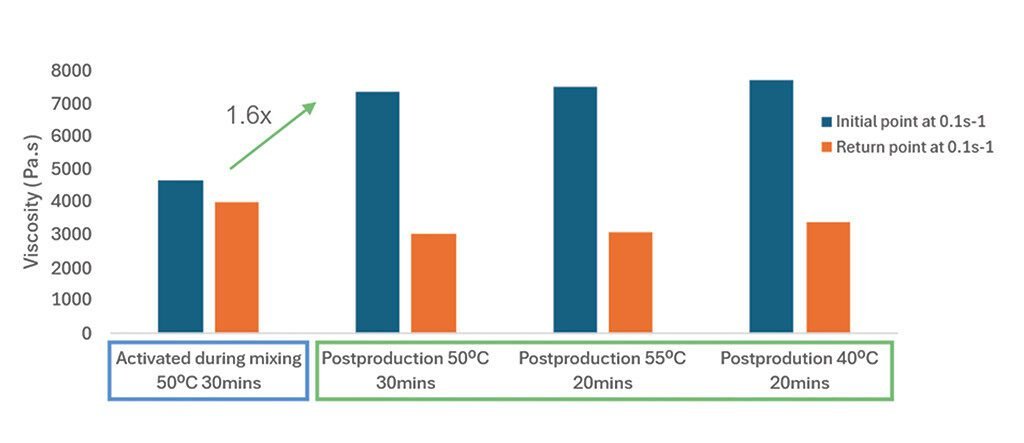
To evaluate the impact of post-production activation, viscosity measurements were performed on a generic silane modified polymer- based using Thixatrol® AS 8053. Samples were activated either during mixing or post-production under different temperatures and time conditions. The graph on Figure 2 illustrates the initial and return viscosity values, highlighting the effectiveness of the new activation approach.
Post-production activation at various temperatures and times achieves comparable or higher initial viscosity compared to traditional in-process activation.
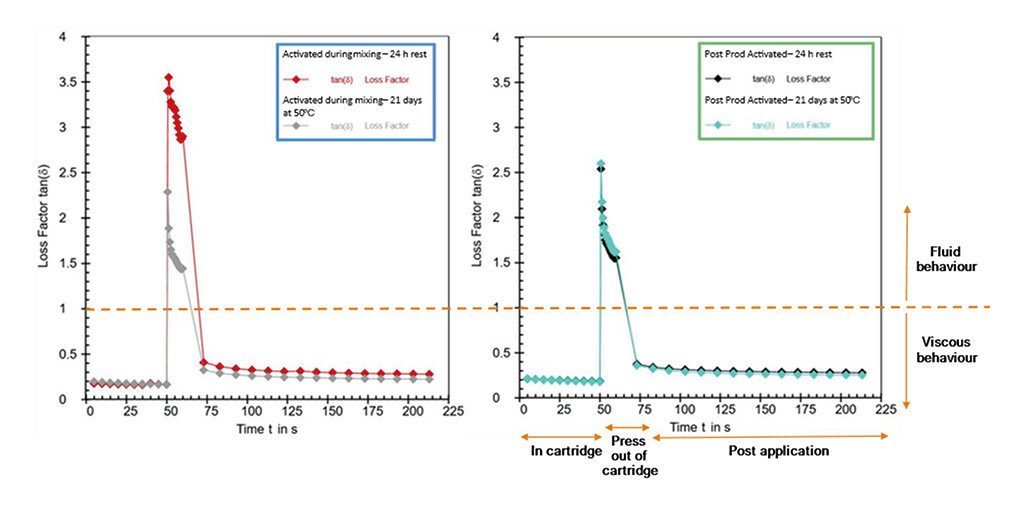
Return point values indicate thixotropic recovery after shear. To further assess the thixotropic recovery and structural stability of the sealant, interval thixotropy tests were performed. The loss factor (tan(δ)) was measured over time, simulating the transition from in-cartridge storage, through extrusion, to post-application rest. Both in-process and post-production activation methods were evaluated at 24 hours and after 21 days of storage at 50° C. The results demonstrate robust recovery and stable viscous behavior for both approaches, supporting the effectiveness of post-production activation (Fig. 3).
Left panel in Figure 3: shows samples activated during mixing. Right panel in Figure 3: Shows samples activated postproduction. We measured their behavior after 24 hours of activation and again after 21 days at 50° C. The dashed line at tan(δ) = 1 separates fluid-like (more liquid) from solid-like (more elastic) behavior. Both activation methods show good recovery and stable, viscous performance after being applied. These results clearly show that post-production activation with Thixatrol® AS 8053 delivers performance equal to or better than traditional in-process activation. The data on Figure 3 demonstrates that this innovative approach not only matches the effectiveness of established methods but also offers additional process flexibility and efficiency. Customers can confidently adopt post-production activation as a reliable and advantageous alternative for their sealant and adhesive manufacturing.
EFFICIENCY AND PERFORMANCE
• Post-production activation yields higher initial viscosity than in-process activation, but viscosities converge after 1–2 weeks at 50° C storage.
• Energy savings and an increased output rate (up to 20%) are achievable by eliminating in-process heating.
• Stable storage: no viscosity drift before activation; converging viscosities after storage.
• Robust rheology: both activation methods offer final formulations delivering high sag resistance and thixotropy after activation.
• Flexible process: Suitable for various packaging and activation setups.
CONCLUSION
Thixatrol® AS 8053 enables on-demand activation for sealants, offering a flexible and energy-efficient alternative to traditional mixing activation. With stable viscosity, reliable performance, and simplified processing, it supports modern production needs, especially for cartridge-based systems.
This leaflet presents an innovative concept for post-production activation. Customers are encouraged to conduct their own tests to optimize activation conditions for their specific systems and packaging formats. For technical support and further guidance, please contact your Elementis representative.