
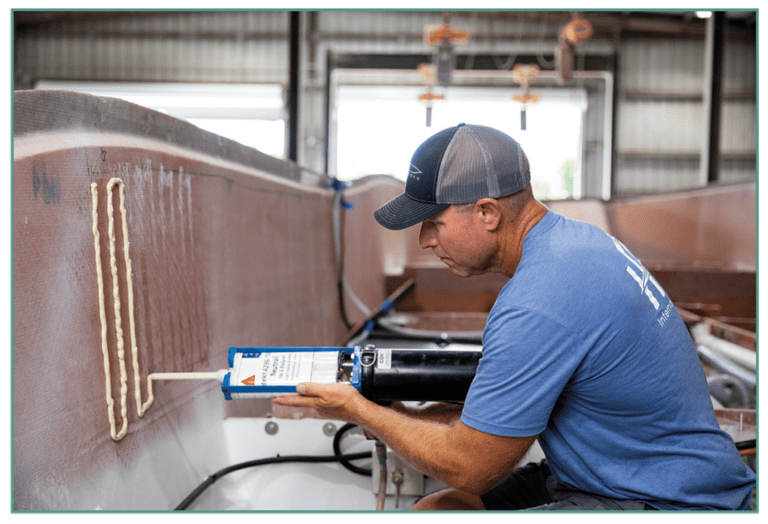
Composite boat construction increasingly relies on structural adhesive bonding for primary joints such as stringers, bulkheads, and deck‑to‑hull connections, because it enables faster, cleaner production with better damage tolerance than purely laminated or mechanically fastened joints.
While MMA adhesives are frequently over-specified due to their high mechanical strength, this paper argues that structural polyurethanes provide a superior balance of strength, elasticity, processability, and cost efficiency for most marine applications.
Excessive strength without regard to load behavior, heat generation, and production realities can increase risk rather than reduce it.
ROLE OF ADHESIVE BONDING IN COMPOSITE HULLS
The construction of GRP boats is usually carried out by molding the hull and deck separately and then joining them together. At the same time, the internal structure (stringers, floors, and bulkheads) is adhesively bonded to a cured hull shell.
This approach avoids drilling through laminates for mechanical fasteners, which preserves fiber continuity, improves fatigue life and simplifies sealing of critical joints.
Key functions of adhesive‑bonded joints:
- Transfer global loads between the hull, deck, and internal grid without stress concentrations from bolts or screws.
- Provide gap‑filling capability to accommodate molding tolerances, especially at stringer landings and bulkhead flanges.
- Improve acoustic damping and vibration behavior compared with stiff tabbing only.
COMMON STRUCTURAL ADHESIVES FOR COMPOSITE BOAT BUILDING
Structural MMA adhesives
MMA (structural acrylic) adhesives have become standard in many composite boatyards because they combine high lap‑shear strength with useful flexibility and excellent adhesion to cured polyester/vinyl ester laminates with minimal surface preparation. They offer rapid cure and good gap‑filling, which is attractive for stringer, bulkhead, and deck‑to‑hull bonding where cycle time is critical.
However, MMAs generate significant exothermic heat in thick bond lines, which can cause surface deformation or bond‑line read‑through, especially on light skins and gelcoats; in addition, their strong odor and VOC emissions impose ventilation and HSE burdens in closed molding shops. These factors can limit bead size or require staged application on large boats, adding complexity for high‑volume production.
Structural polyurethane adhesives
Structural polyurethanes provide a combination of flexibility, impact resistance, and structural strength well matched to dynamic marine load cases and dissimilar joint designs.
Their lower crosslink density compared with rigid acrylics and epoxies allows them to absorb differential movement between hull, deck, cores, and internal structure without cracking, which is valuable in long deck‑to‑hull seams and large bulkhead T‑joints.
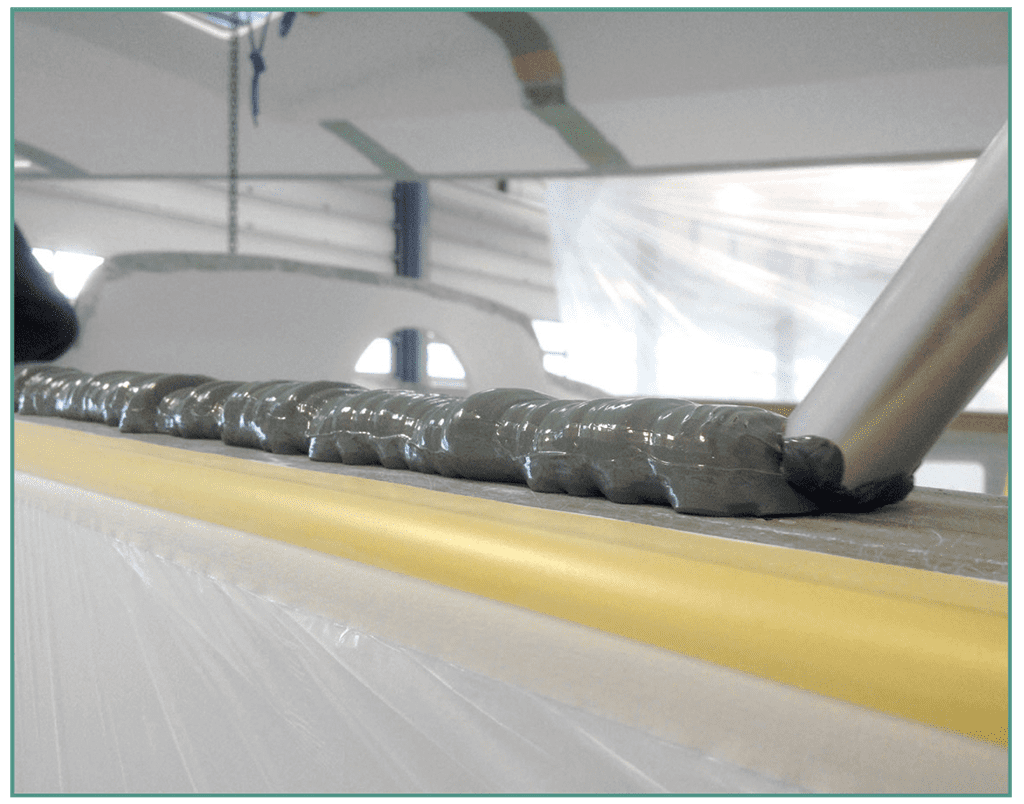
From a process standpoint, two‑component polyurethanes, such as SikaForce®-436, are available with tailored open times and viscosities, and they work efficiently with meter‑mix‑dispense equipment for high‑volume, repeatable stringer and grid bonding. SikaForce®-436 is an IMO, RINA and BV approved marine‑grade systems that exhibit low odor and lower exotherm in thick sections, reducing the risk of heat‑induced defects such as gelcoat read‑through, print‑through of the bond line, and local warpage or cracking of thin skins.
STRENGTH IS NOT THE SAME AS STRUCTURAL SAFETY
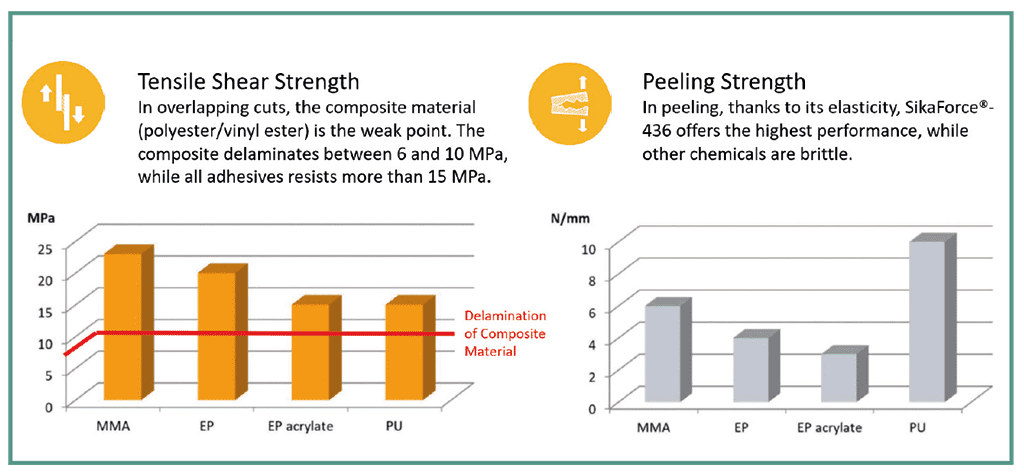
A common misconception in boat design is that higher adhesive strength automatically equals a safer structure.
Composite hulls are flexible and subjected to dynamic, cyclic loads, making stress distribution essential for longterm durability. When adhesive bonds are overly stiff, they can transfer loads directly into the surrounding laminate, increasing the risk of edge cracking and reducing fatigue life. In many cases, MMA adhesives exceed the strength of the composite itself, shifting failure modes from the bond line into the laminate. While MMAs are frequently justified by impressive laboratory performance, realworld production conditions reveal important drawbacks, including strong odor, narrow processing windows, increased health and safety requirements, and a higher risk of scrap and rework. In high-volume boat building, process robustness and repeatability often outweigh marginal gains in ultimate strength.
MMAs can be appropriate for bonding dissimilar substrates, controlled thin bond lines, or localized reinforcement.
However, their blanket specification for structural bonding in composite boats is rarely justified from either a technical or economic standpoint.
BENEFITS OF STRUCTURAL POLYURETHANES FOR COST‑EFFECTIVE PRODUCTION
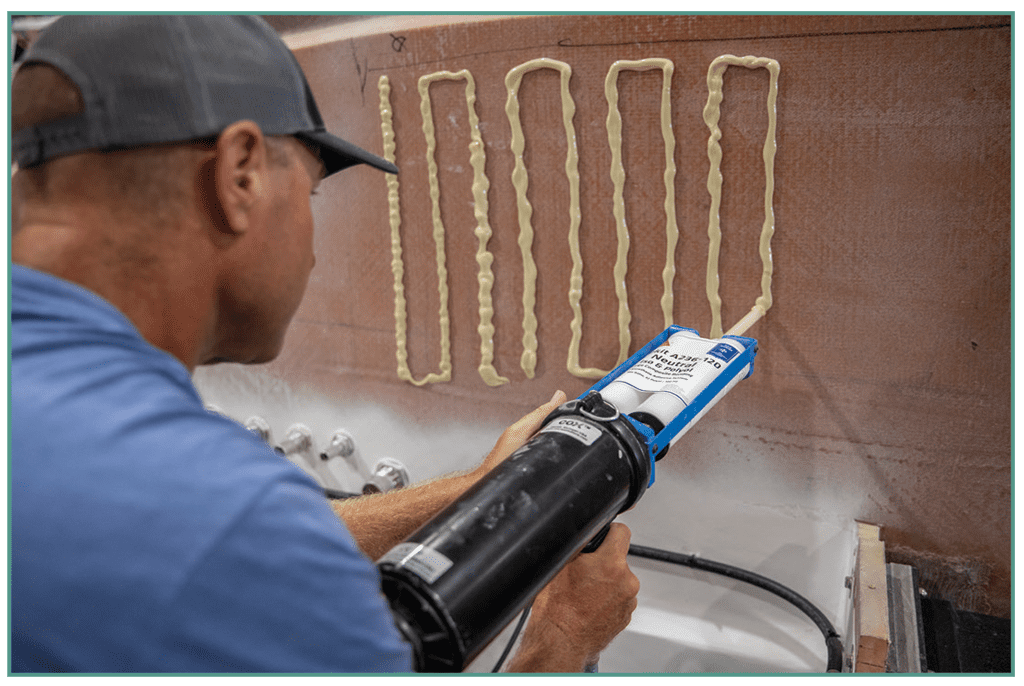
Improved application and shop environment Polyurethane adhesives’ rheology and cure profile support continuous, high‑volume application with robotic or manual meter‑mix guns, allowing long, continuous beads for stringers, bulkheads, and deck‑to‑hull joints without frequent cartridge changes.
Latest developments like Sika’s Cure by Design technology allow reaching beyond typical limits by further optimizing the combination of long working time with fast cure time.
- Faster tack times with fewer interruptions for adhesive changeover or odor‑related ventilation cycles.
- Lower exotherm and reduced cosmetic rework.
Because polyurethanes typically develop lower peak exotherm than fast MMA or heavily filled polyester pastes, they minimize thermal gradients and shrinkage around thick bond lines. This reduces bond‑line read‑through, gelcoat print‑through, and distortion in topsides and decks, which are common sources of cosmetic rework and warranty claims.
Reduced heat‑induced damage leads to:
- Less post‑cure fairing and painting to hide telegraphing at stringer and bulkhead locations.
- Lower risk of micro‑cracking and long‑term crazing around deck‑to‑hull joints subjected to sunlight and thermal cycling.
STRUCTURAL PERFORMANCE AND LIFECYCLE COST
The combination of strong adhesion, toughness, and flexibility gives polyurethane‑bonded joints superior fatigue performance under wave‑induced hull flexure and slamming loads, particularly at transitions between stiff bulkheads and relatively flexible hull panels. By reducing crack initiation and propagation, these joints help maintain stiffness and alignment over the vessel’s life, lowering the probability of structural repairs or intrusive re‑tabbing.
When production labor, rework, ventilation, and warranty exposure are considered, structural polyurethane systems can deliver a lower total cost of ownership for the yard than alternatives, even if unit material cost per kilogramis higher than polyester paste and comparable to MMA.
However, the indiscriminate pursuit of maximum strength has led to the over-specification of MMA adhesives. For series‑built composite boats, the balance of application efficiency, cosmetic stability, and durable performance makes structural polyurethanes a compelling choice for stringers, bulkheads, and deck‑to‑hull bonding.