
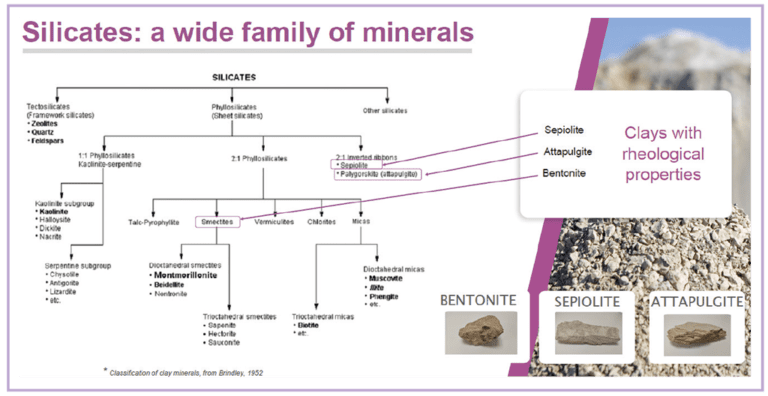
One of the most common questions I receive from clients concerns which clay is better to use—sepiolite or bentonite—in materials such as mortars, tile adhesives, putties, plasters, etc.
Traditionally, due to global availability and resource accessibility, bentonite has been more widely used, while sepiolite has played a more ‘shadow role’, being less known and less applied.
MINERALOGICAL AND STRUCTURAL FUNDAMENTALS: THE ORIGIN OF RHEOLOGICAL DIFFERENCES
The different performance of bentonite and sepiolite in drymix mortars (DMM), tile adhesives, plasters, and putties is rooted in their crystal structures, which govern their gelation mechanisms upon hydration. These minerals are essential rheological additives, controlling viscosity, thixotropy, and sag resistance.
THE LAMELLAR STRUCTURE OF BENTONITE (MONTMORILLONITE)
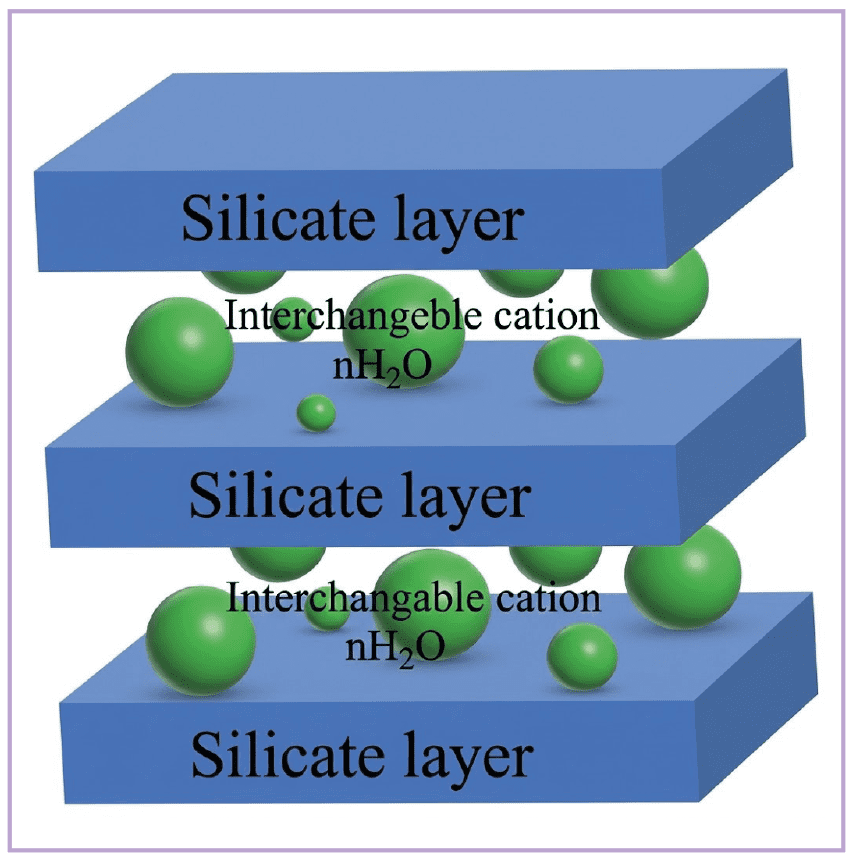
Bentonite is a smectite clay, a 2:1 phyllosilicate with a lamellar morphology. Sodium bentonite is the most commonly used for rheological applications due to its superior swelling properties. Its gel structure forms through interlayer swelling, absorbing water between silicate sheets and expanding 15–25 times its original volume (or 30–50 times its weight). The thickening mechanism is predominantly electrochemical: dispersed platelets interact via attraction-repulsion forces (mainly edge-to-face), forming a 3D colloidal network known as the ‘House of Cards’.
This rigid network gives bentonite high static water retention, a high liquid limit, and notable plasticity.
In civil engineering applications, this plasticity is critical: bentonite enables plastic concrete, flexible waterproof plaster, and chemically resistant barriers, capable of moving with the substrate without cracking.
THE FIBROUS STRUCTURE OF SEPIOLITE (CHAIN-LAYER CLAY)
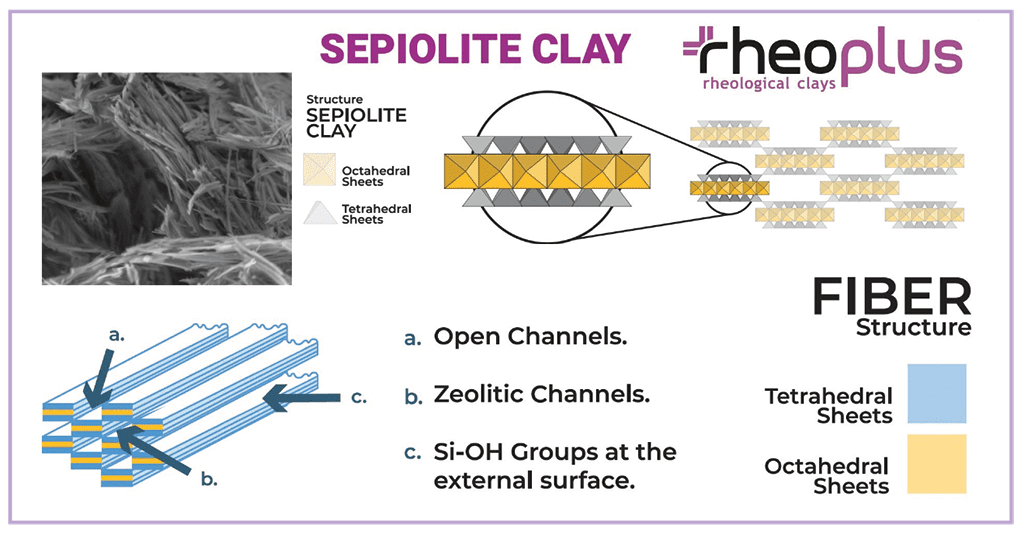
Sepiolite, in contrast, is a magnesium silicate, structurally related to palygorskite (attapulgite) and mineralogically distinct from montmorillonite. Its morphology is fibrous, needle-like. Sepiolite is non-expansive, highly porous, and very low in density, with a large surface area. Its thickening mechanism is primarily mechanical, based on the physical entanglement of its fibers, further reinforced by hydrogen bonding interactions between them, which enhance the stability and strength of the network. Unlike bentonite, sepiolite does not swell significantly; instead, it absorbs water in the microporous channels of its structure.
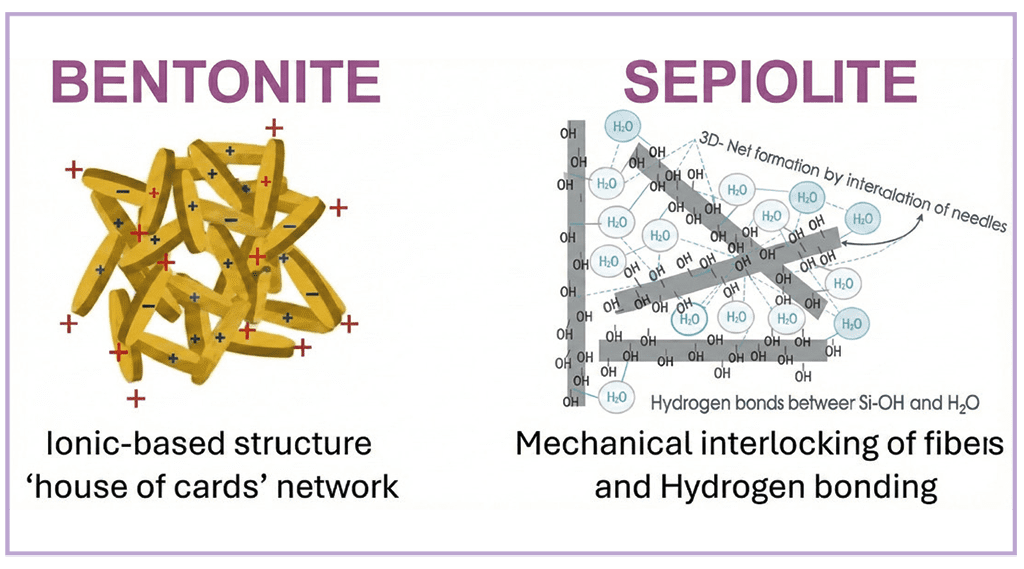
Viscosity and network formation arise from physical fiber interactions, especially under high shear. This gives sepiolite high absorption capacity, retaining its own weight in water. Its rheological mechanism makes it ideal for dry-mix systems, where consistency and stability are paramount.
The structural difference between lamellar swelling (bentonite) and fibrous entanglement (sepiolite) translates into a key functional trade-off for formulators: Sag control vs. Thixotropic Recovery.
Static gel strength and sag control: Vertical sag resistance (sag control) and stability against sedimentation at rest are directly correlated with the static yield limit (τ₀) or the material’s yield stress. Bentonite generates gels with higher initial static strength than sepiolite. The robustness of the bentonite ‘House of Cards’ network provides a high ‘Yield Point’, which is essential for the stability of freshly applied mixtures. This high Yield Stress is a fundamental requirement, particularly in large-format or heavy tile adhesives applied vertically, where preventing slippage or sag immediately after placement is critical. Bentonite, or its refined derivatives, is therefore the natural choice when the absolute priority is to maximize anti-sag performance at rest. Dynamic workability and thixotropic recovery: Workability is defined as the ease with which the mortar can be applied and spread under shear (low dynamic viscosity) and the speed at which it recovers its internal structure once the stress ceases (high thixotropy). Sepiolite exhibits a significant advantage in this regard, achieving superior workability at a gel strength comparable to that of bentonite. This improvement is evident in dynamic rheology: sepiolite shows a faster thixotropic recovery. When the fibrous structural network of sepiolite is broken by shear (e.g., during trowel application), it physically re-entangles almost instantly once the tool is removed. This rapid reconstitution of the structure is crucial to maintaining the shape of mortar ridges (layer thickness) and ensuring a uniform finish, preventing particle re-settling or ridge collapse, ultimately resulting in easier and faster application.
STABILITY IN CEMENTITIOUS SYSTEMS: HIGH PH AND CALCIUM IONS
The performance of any mineral additive in construction is conditioned by high pH and Ca²⁺ ion concentrations released during Portland cement hydration.
- Bentonite: Vulnerable to flocculation under high Ca²⁺ concentration; its lamellar network collapses, reducing viscosity and yield stress. Pre-hydration or highly modified grades are needed to maintain performance, which increases cost and handling complexity.
- Sepiolite: Structurally more robust in ionic environments. Its fiber-entanglement mechanism is no sensitive to high Ca²⁺, providing predictable and stable rheology, essential for dry-mix formulations.
IMPACT ON KEY APPLICATIONS
Tile adhesives: Sepiolite provides the optimal balance between sag control and workability. Its rapid recovery after shear improves coverage and mortar ridge stability. Both bentonite and sepiolite are used synergistically with cellulose ethers (HPMC) to fine-tune rheology. Mortars, plasters, and putties: Bentonite contributes water retention and impermeability, ideal for sealing mortars. Sepiolite excels in suspension stability, preventing sedimentation and ensuring uniform application, particularly in thicker layers.
Formulation Strategy: The choice between bentonite and sepiolite depends on the desired functional outcome:
- high water retention and static yield: Bentonite.
- Optimal workability, thixotropy, and dosage efficiency: Sepiolite.